Most meal prep content sells an aesthetic that almost no household actually keeps up. A row of matching containers, a full Sunday afternoon at the stove, a week of eating the same thing on repeat. By midweek, half those containers are forgotten at the back of the fridge and the takeaway menu comes out anyway. The realistic version of meal prep is much smaller, far less photogenic, and quietly effective. It rests on one shift in thinking: prepare flexible components rather than finished meals.
Prep components, not meals
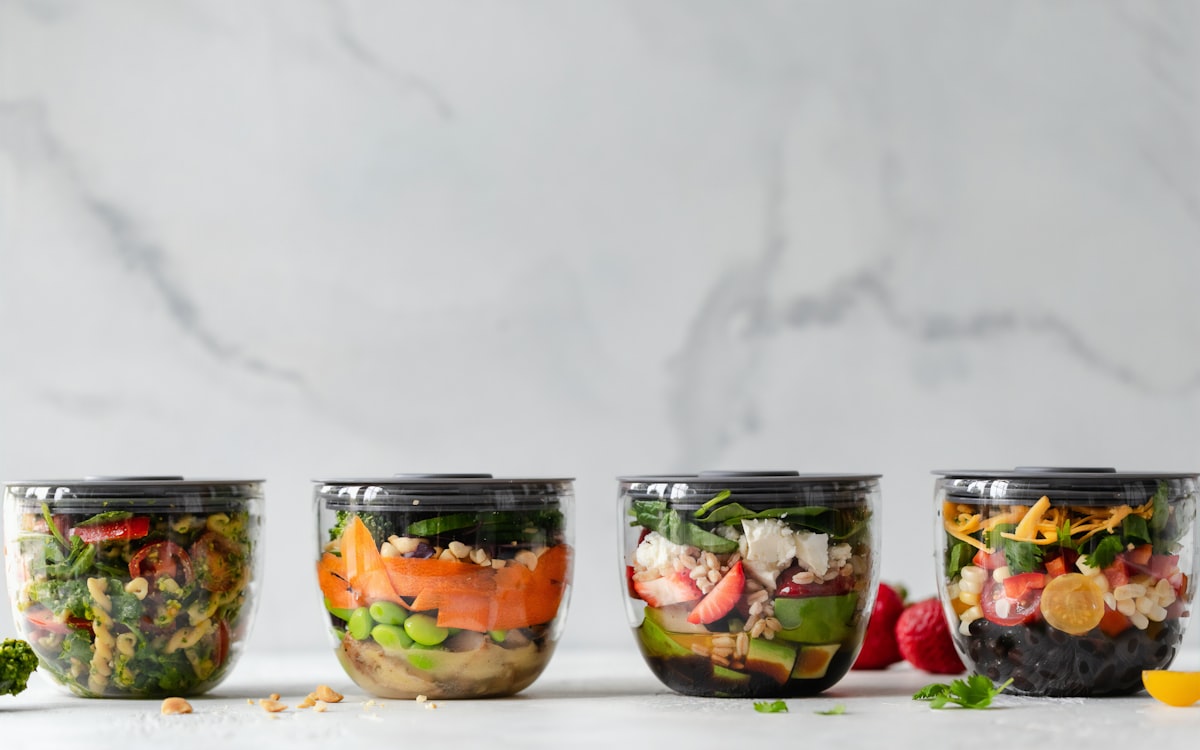
Instead of assembling several complete dinners in advance, cook a few building blocks that combine in different ways. A pot of grains. A tray of roasted vegetables. A protein cooked in a batch. A jar of dressing. On their own, each is unremarkable. Together they become a week of lunches and dinners without you committing to any single dish on Sunday. Grains with roasted veg and tahini one day; the same grains with a fried egg and hot sauce the next; the veg folded cold into a salad after that. Nothing is locked into a final form until the moment you eat it, which is exactly why it survives contact with a real week.
Cook one anchor and stretch it
If a full component session feels like too much to begin with, start with a single larger cook chosen deliberately to stretch. A pot of chilli, a big frittata, a tray of slow-roasted vegetables. Each of these can carry several lunches and a run of dinners across the week, showing up in a slightly different shape each time: chilli over rice one day, folded into a wrap the next, spooned over a baked potato later on. One deliberate cook, many meals, and very little of the sameness that kills enthusiasm by Thursday.
A worked example of one focused hour
It helps to see how little the whole thing actually asks of you. Pick four parts and get them going together rather than one after another. Fill a large pot with grains and set it to simmer. While it cooks, chop a couple of trays of vegetables, toss them in oil and slide them into the oven. Put a pan of eggs on to boil on a back burner. In the two minutes that leaves you, stir a jar of dressing together. Inside an hour, mostly unattended, you have grains, roasted vegetables, boiled eggs and a sauce cooling on the side.
From there the week almost writes itself, without a single fixed recipe. Grains, roasted veg and a spoon of dressing make a bowl on the first day. The same grains under a fried egg and hot sauce read as a different meal on the second. On the third, the cold roasted veg goes into a salad with a boiled egg on top. Later in the week the last of the grains gets reheated with a splash of water and whatever is left of the sauce. You are not following a menu, you are recombining parts, and that is the difference between prep that lasts the week and prep that gets abandoned by Wednesday.
A few building blocks worth keeping
A handful of small habits do most of the heavy lifting. None takes real effort, and each earns its keep across the whole week.
A pot of grains as your base
Cook a large batch of rice, barley, bulgur, or whatever grain your household actually finishes. Cooked grains keep for three to four days in a fridge at or below 4°C, so a single pot covers most of the working week on its own. Spread any you will not reach in time flat inside a bag and freeze it; from frozen it reheats in minutes with a splash of water. Grains are the quiet workhorse of component prep: they carry a sauce, bulk out a salad, sit under a fried egg, or soak up the juices of last night’s roasted vegetables. If you were only ever going to prepare one thing ahead, a pot of grains would be a defensible choice.
A ready salad foundation
Washed and chopped greens, sliced cucumber, a bowl of dressed kale, or a simple grain salad kept in the fridge turns lunch assembly from a chore into a quick job. It also makes it far easier to reach the World Health Organization’s guidance of at least 400 g, or five portions, of fruit and vegetables a day, because the vegetables are already prepared and sitting in front of you rather than waiting to be washed and chopped when you are tired and hungry.
A batch of boiled eggs
Eggs boiled ahead cover breakfasts, snacks, salad toppings and emergency protein. They are cheap, they keep well, and they ask for almost nothing on the weekend in return for a week of usefulness. If you do only one thing on a Sunday, this is a strong candidate.
A sauce for the week
A single sauce or dressing made in advance is what turns a rushed weeknight assembly into something that tastes deliberate. A tahini dressing, a sharp vinaigrette, a quick peanut sauce, a tomato base: one jar pulls otherwise plain components into a coherent meal. If you prepare nothing else ahead, make it grains and a sauce; between them they can handle lunches, dinners and snacks with barely any extra thought.
There is a quieter benefit to making it yourself. Shop-bought dressings and sauces are often where hidden salt and sugar quietly accumulate, and a homemade jar puts you back in charge of both. The World Health Organization suggests keeping salt under 5 g a day and free sugars under 10 percent of energy intake, ideally under 5 percent. A vinaigrette or a tahini dressing you stirred together yourself is easy to keep well within those numbers, whereas a bottled equivalent often is not, and you rarely notice the difference in taste.
Why components beat full meal prep
Full meal prep usually fails for one reason: boredom. After a few days of the same complete dish, most people quietly lose interest, and the last containers go to waste. Components survive variety because they recombine into something that reads as new each day. The same grains under a different sauce, beside a different vegetable, feel like a different meal. You keep most of the flexibility of cooking fresh while banking most of the time in advance. And the time saving is genuine: one focused block of preparation returns far more than it costs across a week of weeknights where the hard part is already done.
Store it so nothing gets forgotten
The classic prep failure is not spoilage so much as invisibility: food pushed to the back, out of sight, remembered only once it has turned. This matters more than it first sounds. Households are responsible for the majority of food wasted worldwide, around 60 percent of the global total, roughly a billion meals thrown away every day, and about 79 kilograms per person over a year. Cook-ahead food that quietly rots at the back of the fridge is a small, domestic version of the same problem, and it inflates the weekly bill for no benefit at all.
A little order fixes most of it. Use clear containers, label each with the day you cooked it, and keep a “use first” zone at the front of the fridge where you cannot miss it. Cooked leftovers keep three to four days at or below 4°C, so anything you will not eat within that window is better moved to the freezer, kept at 0°F (-18°C), while it is still good rather than left in hope. Portion it into single servings before it goes in, so you can pull out exactly what you need later without thawing the lot. As a general rule, do not let cooked food sit out at room temperature for more than two hours before it goes back into the cold, and no more than one hour if the kitchen is above 90°F.
Reading the dates on what you keep
A surprising amount of avoidable waste comes from misreading the date printed on a packet. Except for infant formula, those dates are not required by federal law and are not safety indicators. A “Best if Used By” date speaks to quality, not safety: food showing no signs of spoilage is generally fine to eat past it. This matters for component prep because the yoghurt, the eggs, or the jar of sauce you have built a week of meals around often gets binned a day early on the strength of a printed date rather than a look, a smell, and a moment of judgement. Trust your senses on the things you cooked yourself, keep track of when you made them, and lean on the same common sense for the packets you bought. Between the fridge, the freezer and a sensible reading of the labels, very little of what you prepare needs to be lost.
What to skip
Not all prep earns its place, and some of it actively backfires. Be willing to skip:
- Vegetables cut so far ahead that they wilt or weep before you get to them.
- Complete meals you already suspect you will be tired of by the end of the week.
- Aspirational cooking that ignores what your household will genuinely eat.
Honest prep starts from the food you know gets finished, not the food you wish you ate. If a component regularly ends up in the bin, that is useful information: drop it, and put the effort somewhere it lands.
Build it up slowly
You do not need to arrive at the full system in a single weekend. Start with one component, boiled eggs, say. Once that feels automatic, add a sauce. Then a pot of grains. Built up a habit at a time, the routine settles in without ever feeling like a project you have to summon the will for. Households that get there tend to report the same quiet dividends: calmer weeknights, less takeaway, a smaller food bill and noticeably less Sunday dread. None of it needs a fridge full of matching containers or a photo shoot, only a willingness to cook a little ahead and to keep it loose enough that a real week can bend it without breaking it.
Frequently Asked Questions
Do I have to meal prep on a Sunday?
No. Any day with an hour available works. Some households prefer prepping mid-week (Wednesday) to reset the second half of the week.
How long do prepped components keep?
Most cooked components last 3-4 days in the fridge. Some (cooked grains, roasted vegetables) freeze well for longer storage. Salad components are best within 2-3 days.
Will I get bored eating the same components?
Less than with full prepped meals. Components recombined differently feel like different meals. Add a fresh element each day (a herb, a sauce, a contrasting vegetable) and variety stays high.
Is this approach more expensive than full meal prep?
About the same. The buying patterns are similar; only the assembly differs. Both are typically cheaper than not prepping at all.
What is the single highest-return component to start with?
A pot of cooked grains and a sauce. Together they handle lunches, dinners and snacks all week with minimal additional effort.