Cutting family food costs is usually framed as a trade-off between affordability and nutrition. The friendlier truth is that many of the cheapest foods are also among the most nourishing. The task is not to treat cheap food as an emergency measure to be endured, but to rebuild the family’s ordinary eating pattern around a small set of ingredients that happen to be both inexpensive and genuinely good for everyone at the table.
Build around cheap, nutrient-dense staples
A short list of ingredients does most of the work: eggs, dried beans and lentils, oats, frozen vegetables, tinned tomatoes, brown rice, cabbage, carrots and peanut butter. Together these cost a fraction of premium “family food” ranges while delivering strong nutrition per pound spent. Frozen vegetables deserve particular mention. They are picked and frozen quickly, keep for weeks without spoiling, and make it realistic to reach the World Health Organization’s guidance of at least five portions of fruit and vegetables a day without the waste that fresh produce so often brings.
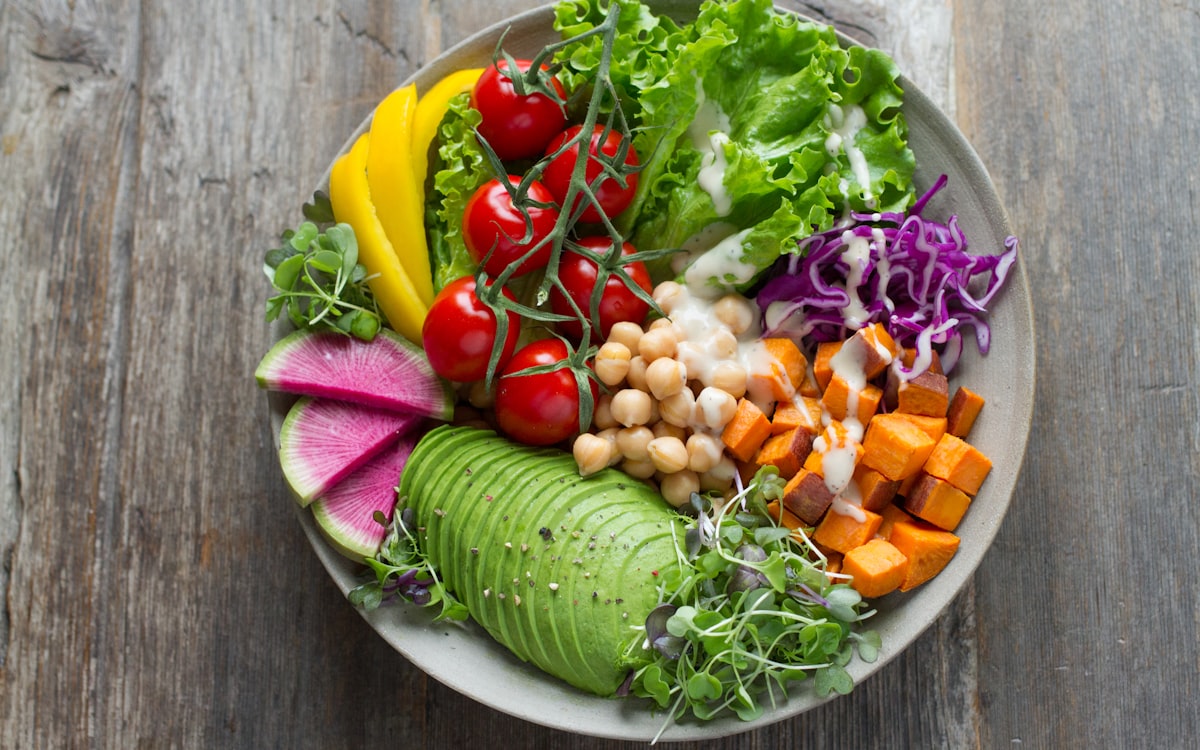
It helps to think of these staples as doing different jobs rather than as interchangeable cheap food. Dried beans, lentils and eggs carry the protein. Oats, rice and bread carry the slow-release energy that keeps a meal filling. Frozen and tinned vegetables, along with cabbage and carrots, carry the fibre and the bulk that make a plate satisfying. When a single meal draws one item from each of those groups, it tends to fill people up without anyone reaching for a second, more expensive round. The WHO target of at least 400 g of fruit and vegetables a day can sound demanding, but a generous handful of frozen peas stirred into a stew, or a tin of tomatoes cooked into a sauce, already covers part of it meal by meal, with almost nothing thrown away.
A five-dinner rotation
Structure beats willpower, so keep a short, repeatable set of dinners you can cook without much thought. One: lentil and tomato stew with rice. Two: pasta with white beans and broccoli. Three: black beans with rice and eggs. Four: vegetable curry with chickpeas. Five: vegetable soup with crusty bread. Each of these costs a fraction of an average family meal while providing balanced nutrition, and because the ingredients overlap heavily, a single weekly shop covers the whole rotation with very little left over.
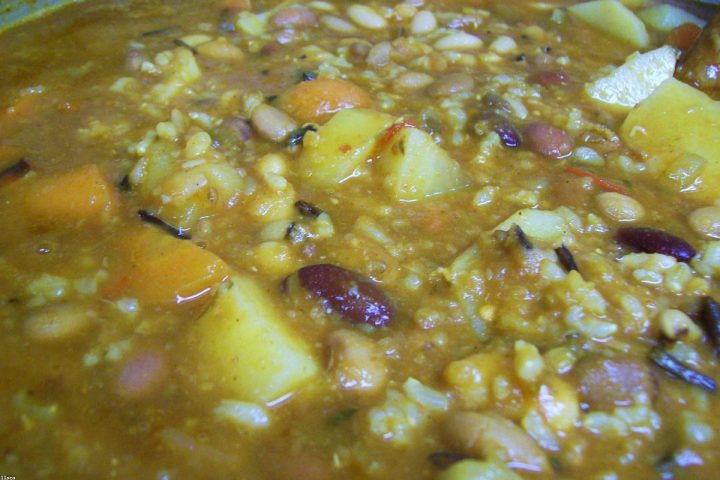
Take the lentil and tomato stew as a worked example. Soften an onion and a clove or two of garlic in a little oil, add a tin of tomatoes, a couple of handfuls of red lentils and enough water to cover, then simmer until the lentils collapse into the sauce. Season with whatever spices you keep to hand and serve over rice, with a handful of frozen peas stirred through at the end for colour and a portion of vegetables. Nothing on that list is expensive, the whole pot cooks in one pan, and the same store cupboard covers three of the other four dinners. That overlap is the real saving. A rotation costs less than a varied menu not because any single meal is austere, but because the shopping trolley stops filling with one-off ingredients that get used once and forgotten at the back of a cupboard.
Spend the premium where it multiplies
Saving on the base does not mean everything must be cheap. A few ingredients act as multipliers: decent olive oil, a small set of good spices, fresh garlic and onions, and a reasonable loaf of bread. These lift the plainest bowl of beans or rice into something people actually look forward to. Premium spending on the base ingredients is rarely worth it; premium on the multipliers usually is. It is a useful line to hold when a shop tempts you to trade up on the wrong things. A jar of dried spices lasts across many meals, so the cost per plate is tiny even when the jar itself is not the cheapest on the shelf. Bland food is what pushes families back towards expensive convenience options, so a little money spent on flavour tends to protect the rest of the budget.
Understand the true cost of convenience
Convenience foods are expensive per portion. Pre-cut produce, pre-cooked grains, premium meal kits and jarred sauces beyond the basics all carry a steep markup for the labour they save. Replacing most of them with simple home-prepared versions is where many family budgets find their real room to breathe. This is a straightforward trade of time for money, and it is worth naming honestly rather than pretending it is free: cheaper food generally asks for more cooking. The trick is to be selective rather than absolute. Buying whole carrots and chopping them yourself saves a great deal, while a bag of frozen chopped onions might be worth the markup on a busy weeknight. The aim is to stop paying convenience prices by default, not to ban every shortcut.
Rethink drinks and snacks
Sweetened drinks, juice, premium coffees and bottled water are quietly large lines in a family budget. Shifting most drinking to tap water saves a meaningful amount and offers exactly the same hydration. It also helps with a nutrition target that is very easy to overshoot. The WHO advises keeping free sugars under 10 percent of energy intake, and ideally under 5 percent, and sugary drinks are one of the quickest ways to push a child past that line. Cutting them back tends to improve the diet and the budget at the same time, which is a rare case where the frugal choice and the healthy choice point in exactly the same direction.
Snacks follow the same logic. Single-serve packaged snacks are one of the most reliable hidden costs in family spending, and they rarely offer nutrition in proportion to their price. Many are also high in salt, another figure the WHO asks families to watch by keeping salt under 5 g a day. Home options do the job for far less and tend to be better food: hard-boiled eggs, cheese, fruit, oat-based bars, or popcorn made from kernels rather than bought by the bag. A small tub of homemade snacks packed the night before removes the moment of weakness at the checkout, which is usually where the expensive, salty, sugary options end up in the trolley.
Shop the reductions with confidence
End-of-day markdowns on bread, dairy, produce and proteins can meaningfully lower a family food bill, and it helps to know what the dates actually mean before you hesitate. The USDA is clear that, apart from infant formula, date labels are not required by federal law and are not safety indicators. A “best if used by” date speaks to quality, not spoilage, and food showing no off smells or other signs is generally fine beyond it. The markdown is about timing rather than risk, which makes the reduced shelf one of the easiest savings a careful shopper can take. The habit worth building is to check the reduced section first rather than last, and to have a plan for what you find. A loaf marked down at the end of the day slices and freezes perfectly well, and reduced produce can go straight into that evening’s stew or soup.
Buy in bulk only what you truly use
For staples the family gets through every week, oats, rice, beans and peanut butter, larger packs save a good amount. The rule that keeps this honest is to buy in bulk only what you will actually eat before it turns. Food that sits and spoils is simply money thrown away, and households are already the largest part of that problem. The UN Environment Programme reports that households account for 60 percent of all food wasted globally, around 631 million tonnes in 2022, which works out at roughly 79 kilograms per person each year and about a billion meals binned worldwide every day. Buying to a plan rather than to a bargain is where bulk buying genuinely pays off. Dried goods keep for months and reward stocking up, while a multipack of anything fresh only saves money if the family reaches the end of it before it spoils.
Cook once, eat several times
Family-sized batch cooking is one of the strongest budget tools available. A pot of chilli can serve several dinners and lunches; a roast chicken gives a dinner, then lunches, then a pot of stock made from the carcass. The effort happens once and the meals keep arriving. To make that safe as well as cheap, it helps to know how long cooked food actually holds. FoodSafety.gov advises that cooked leftovers keep for 3 to 4 days in the fridge, so cook on the day you have time and lean on the results through the first half of the week, then freeze the rest for later. The same guidance recommends keeping the refrigerator at 40F (4C) or below and the freezer at 0F (-18C), and not leaving perishable food at room temperature for more than two hours (or one hour above 90F). Cooling a big pot quickly and getting it into the fridge protects both the food and the money spent making it.
Make meat stretch
If meat is in the budget, favour cuts that go further: whole chickens that yield stock and leftover lunches, tougher cuts that braise slowly into substantial meals, and mince that scales across many dishes. Premium cuts are expensive per portion partly because they cook quickly and are eaten in a single sitting, leaving nothing behind to build a second meal from. A useful mindset is to treat meat as a flavouring rather than the centre of the plate. A small amount of bacon or mince cooked into a bean stew carries the taste through the whole pot, so the meat does the work of a much larger portion while the beans and vegetables supply the bulk and most of the nutrition.
Be honest about time, and about the payoff
There is a real trade here. Cheaper family food usually needs more cooking time, and a household with none to spare may have to accept some convenience costs or batch-cook hard at the weekend instead. There is no universal answer, and an honest look at the time you actually have matters more than any rule someone hands you.
Where families do make the shift, the savings across a year are substantial, and the nutrition tends to improve alongside them. Affordable family eating is not a punishment. Done steadily, it produces simpler dinners, calmer kitchens and meaningful room in the household budget. The work is not clever; it is the consistent repetition of a small number of patterns until they stop feeling like effort.
Frequently Asked Questions
How much can a family realistically save on food?
A family currently spending heavily on convenience, takeaway and premium items can easily save 30-50 percent. A family already eating mostly home-cooked has less room but can typically still save 10-20 percent.
Will my children resist budget meals?
Less than parents fear. The transition is real but most children adapt within a few weeks. Familiar dishes (pasta, soup, beans on toast) are usually well-received.
Is it better to cut shop frequency or shop size?
For most families, slightly smaller more frequent shops produce less waste. Weekly with a midweek top-up beats a single fortnightly mega-shop.
How do I balance budget with my food values (organic, ethical)?
Identify the categories where it matters most to you and pay more there. Compensate by being more flexible elsewhere. Most families cannot afford universal organic; strategic organic is realistic.
What is the single biggest budget mistake families make?
Pre-packaged convenience snacks and ready meals. These items quietly add 20-30 percent to many family food bills without providing proportional value.