
The kitchens that waste the most food are rarely the careless ones. More often they belong to attentive people doing a handful of small things in the wrong order. Each habit is innocent on its own. Together they leak food, time and money in ways that are genuinely hard to notice from the inside, because nothing ever looks like waste at the moment it happens. The container that goes off at the back of the fridge did not announce itself when it was pushed there. The extra portion that never got eaten looked, on the night it was made, like sensible planning.
Household kitchens are also where most of the problem sits. According to the UN Environment Programme’s Food Waste Index Report 2024, households are responsible for about 60 per cent of the food wasted worldwide, well ahead of shops and restaurants, and the average works out at roughly 79 kilograms per person each year. The global totals are large enough to feel abstract, at around 631 million tonnes of household food thrown away in 2022, or close to a billion meals binned every single day. That scale is oddly encouraging rather than dispiriting. It means the changes that matter most are the ones within reach of an ordinary kitchen, and none of the five below asks you to cook less or eat differently.
Mistake One: Cooking the Newest Ingredients First
Reaching for the fresh peppers you bought this morning instead of the slightly tired ones already in the drawer feels natural, and it is exactly backwards. The older ingredients have the least time left, so they should be cooked first. The new ones can happily wait a few days. Flipping this single habit tends to reduce waste more than people expect, because it works on the food most likely to be lost.
The practical trick is placement, and it is worth treating a shelf like a queue rather than a pile. Whenever you unpack the shopping, move the older items to the front and the new ones to the back, so the next thing you reach for is the thing that needs eating. This takes a few extra seconds per shop and is the single highest-return habit in this list. Hidden older ingredients are, reliably, forgotten older ingredients. A small worked example makes the point: if half a bag of spinach is already open, that is what goes into tonight’s eggs or pasta, and the unopened bag stays sealed at the back for later in the week. If something clearly will not get used in time, freezing it early rather than late buys weeks rather than days. Bread, grated cheese, chopped herbs, ripe bananas and most cooked leftovers freeze well, and the freezer effectively pauses the countdown on anything you cannot reach in time.
Mistake Two: Cooking the Wrong Quantity
Most household recipes are written to feed more people than are actually at the table. Halving a recipe feels fiddly, so households cook the full amount, refrigerate the surplus with good intentions, and lose part of it to drift. The fix is not eating less. It is scaling honestly.
A two-person household making a soup written for four should expect two portions of leftovers, not four, and should decide in advance which meal those leftovers become rather than hoping they get used somehow. That decision matters more than the arithmetic: leftovers with a named slot (tomorrow’s lunch, Thursday’s quick dinner) get eaten, while leftovers left to fate get forgotten. Writing your usual quantity straight into the recipes you cook often removes the sums entirely. For dishes where the surplus is genuinely useful, cook the surplus deliberately, portion it as you plate up rather than after it has sat out, and label the container with what it is and the day you made it. Most dishes scale cleanly, with no loss of quality, so there is little reason to keep producing surplus you will only half-remember.
Mistake Three: Letting the Fridge Become a Time Capsule
Containers pushed to the back of the fridge until no one can remember what they hold are not a moral failing. They are a sign the fridge lacks visibility. Once a week, ideally the evening before your main shop, it helps to look honestly along the back of every shelf and decide, item by item, what still has a use. Mystery containers are a category of waste in their own right, and they multiply quietly when no one checks. A useful discipline is to keep one shelf, or the front of the middle shelf, as an eat me first zone, and to move anything approaching its limit there as you spot it. That way the food most at risk is also the food most in view.
Part of what keeps that food around is uncertainty about whether it is still safe, and here the printed dates are less help than people assume. The USDA’s Food Safety and Inspection Service explains that, apart from infant formula, date labels are not required by federal law and are not safety indicators. A “Best if Used By” date speaks to quality, not safety, and food showing no signs of spoilage is generally fine past it. That cuts both ways. It means much of what gets binned on the strength of a date is perfectly good, and it means the real test is your own senses: look, smell and check the texture rather than trusting the print. The label tells you when a manufacturer thinks the food is at its best, not the moment it becomes dangerous, and treating those as the same thing sends a great deal of edible food to the bin.
Mistake Four: Buying for an Aspirational Version of Yourself
This is the most universal mistake of the five. The kale bought for five different recipes. The unusual grain from a glossy photo. The tub of yoghurt bought because a new year was starting. The aspirational shop costs money and creates waste because it is built around the cook you imagine being rather than the one who actually stands in the kitchen on a Tuesday night, tired and short on time.
The remedy is plain honesty about your real cooking rhythm. Shop for the dinners you genuinely make, not the ones you wish you made. A short, practical way in is to write down the meals you actually cooked over the past fortnight, and build the next shop around that real list rather than an idealised one. If you want to know your pattern, think back over the last couple of months and notice which experimental ingredients actually got cooked. The answer is usually clear. Keep the experiments small and occasional, adding a single new ingredient at a time rather than folding several into the weekly essentials, where they sit untouched and quietly spoil. Loose fruit and vegetables help here too, because buying by the item rather than the pre-packed bag lets you match the amount to what you will realistically eat.
Mistake Five: Letting Cleanup Pile Up Between Days
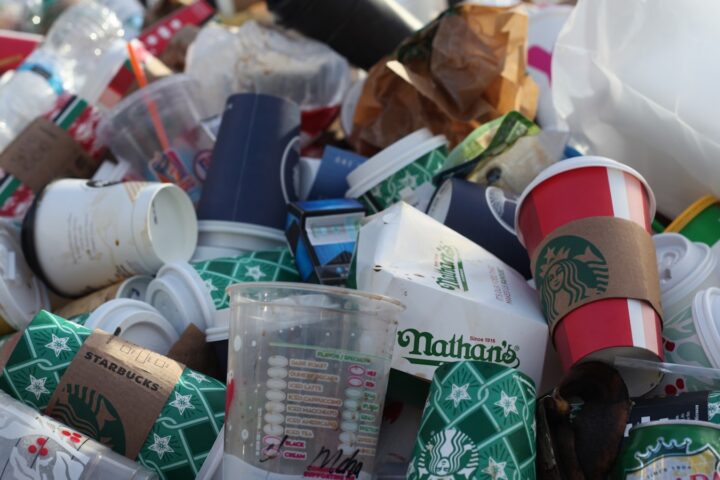
A kitchen still holding last night’s dishes tends to produce more disposable substitutes the next day: paper plates, a takeaway instead of cooking, a coffee bought out rather than made at home. A short cleanup the evening before, even a quick pass before bed, heads off that cascade. The goal is a clear worktop and an empty sink, not a spotless room, because the thing that decides whether you cook tomorrow is whether there is somewhere to chop and a pan you can reach.
Cooking from a clean kitchen feels easy, and easy cooking actually happens. A chaotic one quietly raises the appeal of the takeaway menu, which tends to arrive with its own packaging and, often, more food than anyone needs, feeding straight back into the first four mistakes. The point is not spotlessness. It is starting each day from a surface you are willing to cook on, so that the home-cooked option stays the path of least resistance rather than the effortful one.
The Pattern Behind All Five
Every one of these is a visibility problem wearing a different costume. New ingredients are more visible than old ones. The aspirational version of yourself is louder than the real one. A messy morning kitchen makes the disposable option feel more obvious than cooking. Fixing visibility, in every case, is the actual work: bring the older food, the honest quantity and the real cooking habits to the front of your attention, and the waste falls away without a single new rule to remember. Give it a few weeks and the front of the fridge starts to look deliberately chosen rather than accidental, and the food bill tends to ease without any conscious budgeting.
When Food Does Have to Go
Some waste is unavoidable. Peelings, trimmings, the genuinely spoiled container you sensibly decide against rescuing. Forcing yourself to eat dubious leftovers is its own problem, so when something is clearly past use, let it go without guilt, but give a thought to where it goes. This is where the household habits meet a wider consequence. The US Environmental Protection Agency reports that food waste makes up about 24 per cent of the material sent to landfill, and that landfilled food waste is responsible for roughly 58 per cent of the fugitive methane escaping from municipal landfills. Food sent to landfill breaks down without oxygen and gives off that methane as it rots.
Composting works the other way around. The US Environmental Protection Agency notes that home composting relies on aerobic decomposition, so the methane-producing microbes stay inactive, and the finished compost improves soil structure, helps it hold moisture and nutrients, and reduces the need for fertiliser. In practice this is undemanding: a small caddy on the worktop for peelings, coffee grounds and vegetable scraps, emptied into a bin or heap outside, mixed with a rough balance of green material (the food scraps) and brown material (dry leaves, cardboard, shredded paper) and turned occasionally to let air in. A caddy for scraps turns the small, unavoidable share of kitchen waste into something useful rather than something harmful, and closes the loop on the part of the problem no amount of planning can prevent.
None of this reads like sustainability advice, and that is rather the point. Put the older food at the front. Scale recipes to the people at the table. Look along the back of the fridge each week. Shop for the meals you truly cook. Keep the kitchen clean enough that cooking stays the easy choice. What you are left with is a calmer kitchen and a smaller bin, and the environmental part quietly takes care of itself.
Frequently Asked Questions
How do I make myself use older ingredients first?
Move them to the front of the fridge whenever you put the shopping away. The placement makes the habit automatic. Hidden older ingredients are forgotten older ingredients.
Is it really worth halving recipes?
For most two-person households, yes. The math gets easier with practice. Many recipes scale linearly with no quality loss.
What do I do with the mystery containers I find?
Honest assessment, not heroic rescue. If the contents are clearly past use, compost or bin them and move on. Forcing yourself to eat dubious leftovers is its own problem.
How do I stop buying aspirationally?
Track which experimental ingredients actually got used over the last two months. The pattern will be clear. Limit yourself to one new ingredient per shop until your real cooking rhythm grows.
Why does a clean kitchen reduce food waste?
Because cooking from a clean kitchen feels easier, and easy cooking happens. A messy kitchen quietly increases the appeal of takeaway and disposable substitutes, both of which generate waste.