
Most composting advice starts with the bin. The planning matters more. A well-planned system quietly shrinks the kitchen rubbish bin and stays out of your way; a poorly planned one becomes another household chore that fails within a month. If the goal is the smallest possible bin for the least possible effort, the work happens before you buy any equipment at all. What follows is a plan for keeping the whole setup as compact and as low-friction as it can be.
Start by auditing what you actually throw away
For one week, change nothing. Just watch what goes into the bin. Most kitchens discover that a large share of what fills it is food scraps rather than genuine rubbish: peelings, cores, coffee grounds, tea bags, the ends of things, and plate leftovers. The entire point of a compost plan is to redirect that mass somewhere useful and leave the bin for what truly belongs there. You cannot design the right system until you know, in real terms, what you are dealing with.
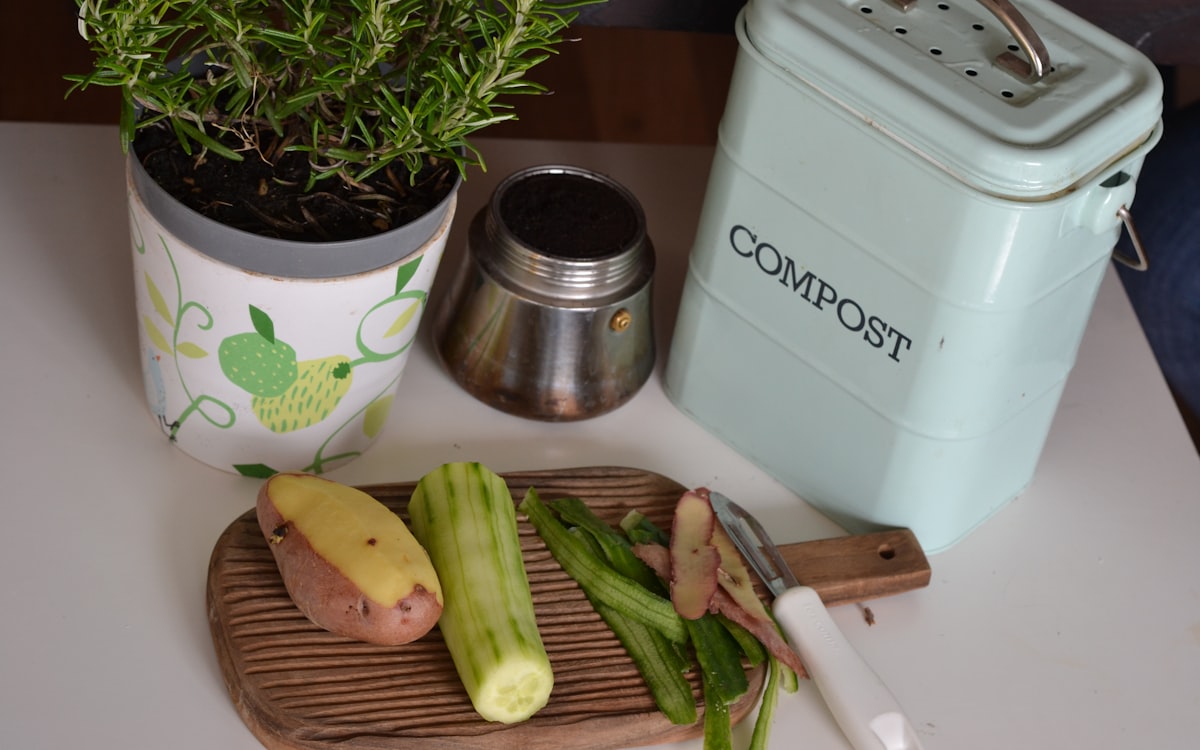
Make the audit concrete rather than impressionistic. Keep a separate bowl or bag on the counter for the week and tip only food into it, weighing it on the kitchen scales each evening or simply noting how full it gets. Watch for patterns as much as totals: a glut of salad leaves that turned to slime, bread gone stale, the outer layers of vegetables you always trim hard. Those patterns tell you two things at once, how much a compost system would need to handle and where you are losing food you could have eaten. A short written tally beats a vague sense that you throw out a lot.
This audit also puts the wider problem in perspective. Households are the largest single source of wasted food anywhere in the supply chain, responsible for the majority of what is thrown away worldwide. According to the UN’s Food Waste Index Report, households account for around 60 percent of all food wasted globally, on the order of 79 kilograms per person each year, and the world throws away roughly 1 billion meals every single day. Seeing your own version of that up close is usually enough motivation to build a system that lasts.
Why the scraps matter more than they look
Food sent to a home compost heap and food sent to landfill break down in completely different ways, and that difference is the whole environmental case for bothering. Buried in a compacted, oxygen-starved tip, food waste rots without air and releases methane, a far more potent greenhouse gas than carbon dioxide over the short term. The EPA’s work on landfilled food waste found that food scraps make up about 24 percent of everything sent to municipal landfills and are responsible for roughly 58 percent of the fugitive methane those landfills emit. A compost heap does the opposite. Because it relies on aerobic decomposition, the methane-producing microbes never get going, as the EPA’s guidance on composting at home explains. The same peelings that would have driven emissions in a tip instead turn quietly into soil. Keeping the process aerobic, turning it and not letting it go sodden and airless, is what keeps a heap on the right side of that line.
Match the system to your home, not to an ideal
Four approaches cover almost every household, and the right one depends entirely on your space and habits.
- Council collection is the easiest option wherever it exists. Someone else does the processing; you only need a caddy and a routine. Check your council’s list of what it accepts, because many kerbside schemes take cooked food, bones, and certified compostable liners that a home heap cannot handle well.
- A community drop-off works for flats with no garden but willing legs, where scraps are collected and walked to an allotment or shared bin. Storing the week’s scraps in the freezer between trips removes the only real drawback, which is smell.
- Indoor bokashi suits the small-flat case, fermenting scraps in a sealed bucket with a sprinkle of inoculated bran so they pickle rather than rot. It copes with cooked food and small amounts of meat that ordinary composting struggles with, but it needs the liquid drained regularly and the fermented mass eventually buried or added to an outdoor heap to finish breaking down.
- Outdoor compost or worm bins fit any home with even a small patch of garden, and give you finished material to use. A worm bin stays compact and works on a balcony, though the worms want shade and steady conditions rather than a baking or freezing corner.
The mistake is choosing the most ambitious system rather than the one your life will actually sustain. Pick honestly.
Map the path from cutting board to caddy
This is the single most important step and the one people skip. If the caddy lives across the room or under the sink behind a cupboard door, scraps end up in the ordinary bin out of sheer inertia. If it sits within arm’s reach of where you chop and prepare food, scraps go where they belong with no thought and no effort. Location is the system. Everything else is secondary to putting the container in the path your hands already take. Test it for a day: prepare a normal meal and notice whether reaching the caddy interrupts the flow of cooking. If it does, move it before you commit to anything larger.
Get the mix right without overthinking it
A caddy or heap that smells sour or draws flies is almost always too wet and too heavy on soft, green material. The remedy is dry, carbon-rich matter mixed in: torn cardboard, scrunched paper, dead leaves, or a handful of wood shavings. Aim for a rough balance between wet green scraps (peelings, coffee grounds, grass clippings) and dry brown material rather than following any exact recipe. Keep out the things that reliably cause problems in a home system: meat, fish, dairy, and oily leftovers draw pests and turn rancid, and those are precisely the items a council scheme or a bokashi bucket handles better. Chop or tear larger pieces so they break down faster, and give an outdoor heap an occasional turn with a fork to let air back in. That single habit prevents most of the failures people blame on composting itself.
Empty it often, on a fixed habit
Indoor caddies should be emptied every few days, not once a week. Smell and fruit flies appear after only a handful of days, and by then the routine feels unpleasant, which is how compost plans quietly die. A short, regular trip to the outdoor bin, the council caddy, or the freezer bag prevents almost every problem people associate with home composting. Tie it to something you already do, so it never becomes a decision: empty the caddy when you carry out the recycling, or on the evening you put the bin to the kerb. A lid that seals properly and an occasional rinse keep the caddy itself from becoming the source of the smell.
Plan for holidays and bad weeks
The freezer bag is the best fail-safe there is. Whenever life makes the normal routine impossible, whether that is illness, travel, or a chaotic week, scraps go into a bag in the freezer instead. There is no smell and no urgency, and the frozen material keeps indefinitely until you can deal with it. Freezing also softens cell walls, so scraps often break down a little faster once they thaw onto the heap. When things return to normal, the bag comes out and the ordinary routine resumes. A system that assumes perfect weeks will fail during the first imperfect one; this is what stops that happening.
Use the output if you have a garden
Home compost is finished when it smells like good soil, holds no recognisable food scraps, and has cooled and darkened into a crumbly texture. Worked into garden beds a couple of times through the year, or spread as a mulch around established plants, it returns to the food system in a genuine closed loop. The benefits are well documented: the EPA’s guidance notes that finished compost improves soil structure, helps the ground retain moisture and nutrients, and reduces the need for added fertiliser. Because the process relies on aerobic decomposition, the methane-producing microbes that thrive in a sealed landfill never get going, so the same scraps that would have released methane instead build soil. Households without a garden can usually give finished compost to community gardens, allotments, or a neighbour who grows things, and most are glad to take it.
The honest time cost
A working setup adds only a few minutes to the week: emptying the caddy, the occasional trip outside, a periodic turn of an outdoor bin. In return, the visible kitchen bin shrinks substantially, often to a fraction of its former volume. Less rubbish to carry out, less odour indoors, and fewer bin liners used. The cost is far smaller than most people fear before they start, which is precisely why the fear stops so many from starting.
Where compost plans go wrong
Composting almost always fails for the same reason: the household tries to do too much. An expensive outdoor system in a yard that does not suit it. Bokashi in a home with no patience for the fermentation routine. A worm bin in a warm, humid kitchen where the worms struggle. The fix is not more discipline but a better match. Choose the system that fits the life you actually live, not the tidier, more diligent version of yourself you keep meaning to become. A modest system you maintain beats an elaborate one you abandon. If a setup has failed once, treat that as data about the design rather than about your willpower.
Composting is the cleanup, not the strategy
Composting is genuinely worthwhile, but it sits behind two larger habits: buying less food than you will waste, and actually using what you buy. Both matter more than anything that happens to the scraps afterwards. A surprising amount of avoidable waste comes from binning food that is still perfectly good, often because of a date on the packet. As the USDA’s guidance on food product dating explains, most of those labels are not required by federal law and are not safety indicators; except for infant formula, a phrase like “best if used by” speaks to quality, not safety, and food showing no signs of spoilage is generally fine to eat past that date. Trusting your senses over the label keeps food out of the caddy in the first place. Plan the compost well, keep it small, and treat it as the tidy end of a longer effort rather than the whole of it.
Frequently Asked Questions
How much does a compost setup cost?
Anywhere from zero (council collection, freezer bag drop-off) to around one hundred for an indoor bokashi setup or a small outdoor compost bin. Cost is rarely the deciding factor.
Does composting attract pests?
Properly managed, almost never. Pests appear when food is exposed, wet or rotting in an open container. Sealed indoor systems and well-managed outdoor systems are pest-resistant.
Can I compost in the winter?
Yes, though outdoor decomposition slows. Indoor systems work year round. The freezer bag method is winter-friendly by design.
How long does it take to make finished compost?
Outdoor compost, three to nine months depending on temperature and turning. Bokashi, two to four weeks plus a few weeks of soil burial. Council collections produce industrial compost on rotating cycles.
Will my neighbours be bothered by smell?
Well-managed compost smells like damp earth, not rubbish. Bad smells indicate a setup problem (too wet, too much nitrogen) which can be corrected by adding more dry material.