Family meal planning content tends to picture a calm parent and two enthusiastic children eating quinoa bowls without complaint. Real family life involves competing schedules, fixed preferences, an energy crash around six o’clock, and a chronic shortage of time. A meal plan that is going to last has to survive all of that, not an idealised version of it. The aim of this guide is a set of patterns sturdy enough to hold up on an ordinary Tuesday, not a photogenic one.
Start with three predictable anchors
Every family already has a handful of meals that everyone eats without protest. A particular pasta, a roast, a soup, a baked dish. Find yours and write them down. These become the spine of the week, the meals you can fall back on when nothing else has been decided. The point of naming them explicitly is that decision fatigue, not cooking, is usually what breaks a meal plan by Wednesday evening. Repetition here is a feature rather than a failure. The goal is a reliable week, not a varied one. Keep the list somewhere visible so the question of what to cook has an answer before anyone is hungry enough to argue about it.
Sort the week into three tiers
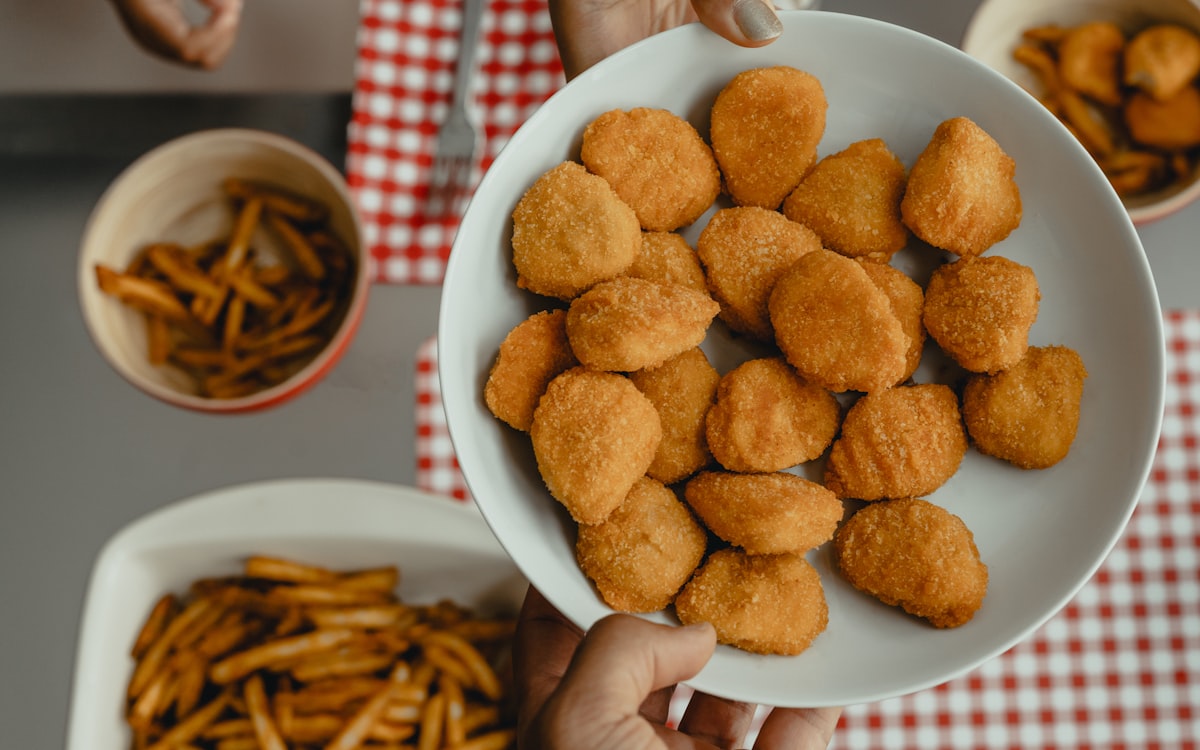
It helps to think of the week in three tiers. The first tier is your predictable family dinners, the ones everyone reliably eats. The second is a few flexible meals, where one person cooks something they like and the children get a familiar variation of it. The third tier is for the nights that fall apart entirely: leftovers, beans on toast, a quick frittata, eggs and toast. Naming that simple tier in advance takes the guilt out of using it, because it was always part of the plan rather than a sign the plan failed. The tiers are there so that a bad day has a plan rather than a panic.
One dish, adjusted for picky eaters
Separate cooking for adults and children is the fastest route to exhaustion. The alternative is to build flexibility into a single dish. Serve the pasta with the sauce on the side, the cheese optional, the vegetables in a bowl that anyone can reach for or ignore. The base is identical for everyone, and each person assembles their own version of it. This handles fussy eaters without turning the kitchen into a short-order counter, and it quietly teaches children that the family eats one meal together, with room to make it theirs.
Take a taco or fajita night as a worked example. You cook one pan of seasoned mince or beans and put out bowls of grated cheese, chopped tomato, lettuce, soured cream and warm wraps. The adult builds a loaded wrap with everything on it. The cautious young one has a plain wrap with mince and cheese, or just the mince and a folded wrap on the side. Nobody cooked twice, the base was identical, and each person assembled the version they would actually eat. The same logic carries a build-your-own pasta, a rice bowl, or a jacket potato with two or three fillings laid out for people to choose from.
A vegetable at every dinner
Put at least one vegetable on the table at every dinner, even if some of the family barely touch it. Repeated, low-pressure exposure is how tastes widen, and it works slowly rather than overnight. The vegetable does not need to be praised or negotiated over. It only needs to be present, available and uncomplicated. The World Health Organization recommends at least 400 g of fruit and vegetables a day, roughly five portions, and spreading that across ordinary meals is far easier than trying to reach it in one heroic salad. A handful of frozen peas counts. So does the tomato and cucumber nobody comments on. Building small amounts into breakfast and lunch as well, a banana on cereal, carrot sticks in a lunchbox, means dinner is not left carrying the whole target on its own.
Balancing sugar and salt without a fuss
Vegetables are the visible part of a balanced plate, but two less visible levers matter just as much for a family eating the same meals week after week: sugar and salt. The same fact sheet from the World Health Organization suggests keeping free sugars under 10 percent of energy intake, and ideally under 5 percent, with salt under 5 g a day. Cooking from a small rotation of home dishes already does most of that work, because the sugar and salt people struggle to control tend to be hidden in sauces, snacks and ready meals rather than in a plain home-cooked dinner. A few small habits do the rest: taste the food before reaching for the salt, use herbs, lemon or spice to add interest instead, and treat sweet drinks and puddings as an occasional item rather than the default. None of this needs announcing at the table. It is simply built into what the family cooks.
Repetition is the point
Most families do better on repetition than on novelty. The same three or four dinners can rotate for months without complaint, provided they are made well. New recipes belong to the weekend, when there is time and patience for something that might not work. Weeknights, with tired parents and hungry children, are the wrong moment to experiment. Treating repetition as the plan rather than a compromise removes a surprising amount of daily pressure.
Small jobs for children
Small jobs give children a stake in the meal. Rinsing vegetables, laying the table, choosing between two options you are happy to serve either way. The food tends to get eaten with less drama when they have had a hand in it, and the practical skills accumulate quietly over the years. None of this needs to be a formal cooking lesson. A few minutes of genuine involvement does more than an elaborate project that nobody has the energy for.
Habits that cut waste and cost
The habits that make family cooking sustainable are unremarkable. Cook once and stretch it across two meals. Buy whole vegetables rather than pre-cut. Keep a bag of frozen vegetables as a backstop. Turn last night’s dinner into today’s lunch. These scale up well for a family precisely because the volume is higher, so the savings on both money and waste compound faster. Cooking this way generally costs noticeably less than a week built around takeaways and ready meals, and the difference is steady rather than dramatic.
Waste is worth taking seriously here. According to the UN Environment Programme’s Food Waste Index Report 2024, households account for 60 percent of all food wasted globally, about 631 million tonnes in 2022, and roughly 1 billion meals are thrown away worldwide every day. Averaged out, that comes to about 79 kilograms of food per person per year, much of it edible and much of it binned at home. The fridge is one of the few places an ordinary person can make a real dent, and a family fridge, feeding more mouths, offers more room to do so.
Reading date labels honestly
A good part of household waste comes down to misreading the label on the packet. The USDA’s Food Safety and Inspection Service explains that, apart from infant formula, date labels are not required by federal law and are not safety indicators. A ‘Best if Used By’ date describes quality, not safety, and food showing no signs of spoilage is generally fine to eat past it. In practice this means trusting your eyes and nose over the printed date for most store-cupboard and fridge staples. Bread, hard cheese, yoghurt, tinned goods and dried pasta rarely turn dangerous on the stroke of a date. Getting into the habit of checking food rather than binning it on sight, and passing that habit on to the children, is one of the simplest ways to stop throwing away meals that were perfectly good.
Storing leftovers so they actually get eaten
Leftovers only help if you eat them in time, and that starts with storing them properly. FoodSafety.gov advises keeping the refrigerator at 40F (4C) or below and the freezer at 0F (-18C), cold enough to slow the bacteria that spoil food. Cooked leftovers keep 3 to 4 days in the fridge, a useful window to plan lunches around before food is quietly forgotten at the back of a shelf. Do not leave perishable food at room temperature for more than two hours, or more than one hour when the kitchen is above 90F, so get the extra portions cooled and into the fridge rather than letting the pan sit out all evening. Anything you will not reach within those few days is better off in the freezer, where an anchor component can wait for a night that falls apart entirely.
Where convenience belongs
A reasonable ready meal once a week, a jar of sauce on a difficult night, the occasional takeaway. None of these are failures. They are sensible accommodations to a real week, and the overall pattern matters far more than any single meal. A plan that demands weekly purity is a plan that will be abandoned within a month. Building the easy options in on purpose is what keeps the whole thing running.
The weekend reset
Most of this holds together with a short weekend reset. Look through the fridge and see what needs using, batch-cook one anchor component, write a small shopping list. This modest investment of time carries the following week with a great deal less friction. The fridge inventory alone tends to prevent the slow accumulation of forgotten food, and it usually reshapes the shopping list so you buy around what you already have rather than on top of it. A practical order helps: check what is close to its date first and plan a meal around it, then decide the anchors, then write the list. Batch-cooking a base such as a tomato sauce, a pot of rice or a tray of roasted vegetables gives you a head start on two or three of the week’s dinners in a single go.
What this looks like over time
Over time, sustainable family eating settles into a modest rotation of dishes the family genuinely accepts, frequent leftovers, vegetables that shift with the seasons, and the occasional treat. Children are gradually exposed to a wider range of foods through repeated, low-pressure presentation rather than pressure at the table. From the outside it looks unremarkable. From the inside it feels calm, which is rather the point.
Sustainable family eating is not an aesthetic to perform. It is a small set of reliable patterns that survive a genuine family week. Done consistently, it feeds everyone well, keeps costs down and reduces waste, without anyone having to announce a dietary identity. The work, such as it is, is mostly the repetition.
Frequently Asked Questions
How do I get picky children to try new foods?
Repeated low-pressure exposure. The food is on the table without comment. Tasting is encouraged but not enforced. Acceptance often takes 10+ exposures over weeks or months.
Is it okay to make different meals for adults and children?
Occasionally yes; routinely no. The added cooking burden usually outweighs the benefit. Shared dinners with optional adjustments work better long-term.
How much should I plan in advance?
A week is the sweet spot. Two weeks becomes unrealistic. A few days at a time works for some families. Match the planning horizon to your household's actual stability.
What about kids' food preferences changing constantly?
Common and not a sustainable meal planning problem. Build the plan around a few stable favourites and allow rotation of less-favoured items at low pressure.
How do I balance family meal planning with social events and travel?
Use the simple tier (tier three) for nights around busy events. Stock the freezer for unexpected disruptions. The system is meant to be flexible, not rigid.